

Last year my favourite day, Marriage Statistics Release Day, was three and a half months ahead of schedule, this year we’re even earlier! Just like last year, it was a surprise when I got my usual daily email from the Australian Bureau of Statistics on 23 July, outlining what had been released, and found it said Marriages and Divorces! Honestly, if they’re early again next year the ABS might need to pay for treatment of my shock!
So now that I’ve recovered and had a few days to get my head straight, here’s my annual rundown of the marriage statistics for 2024.
Number of marriages
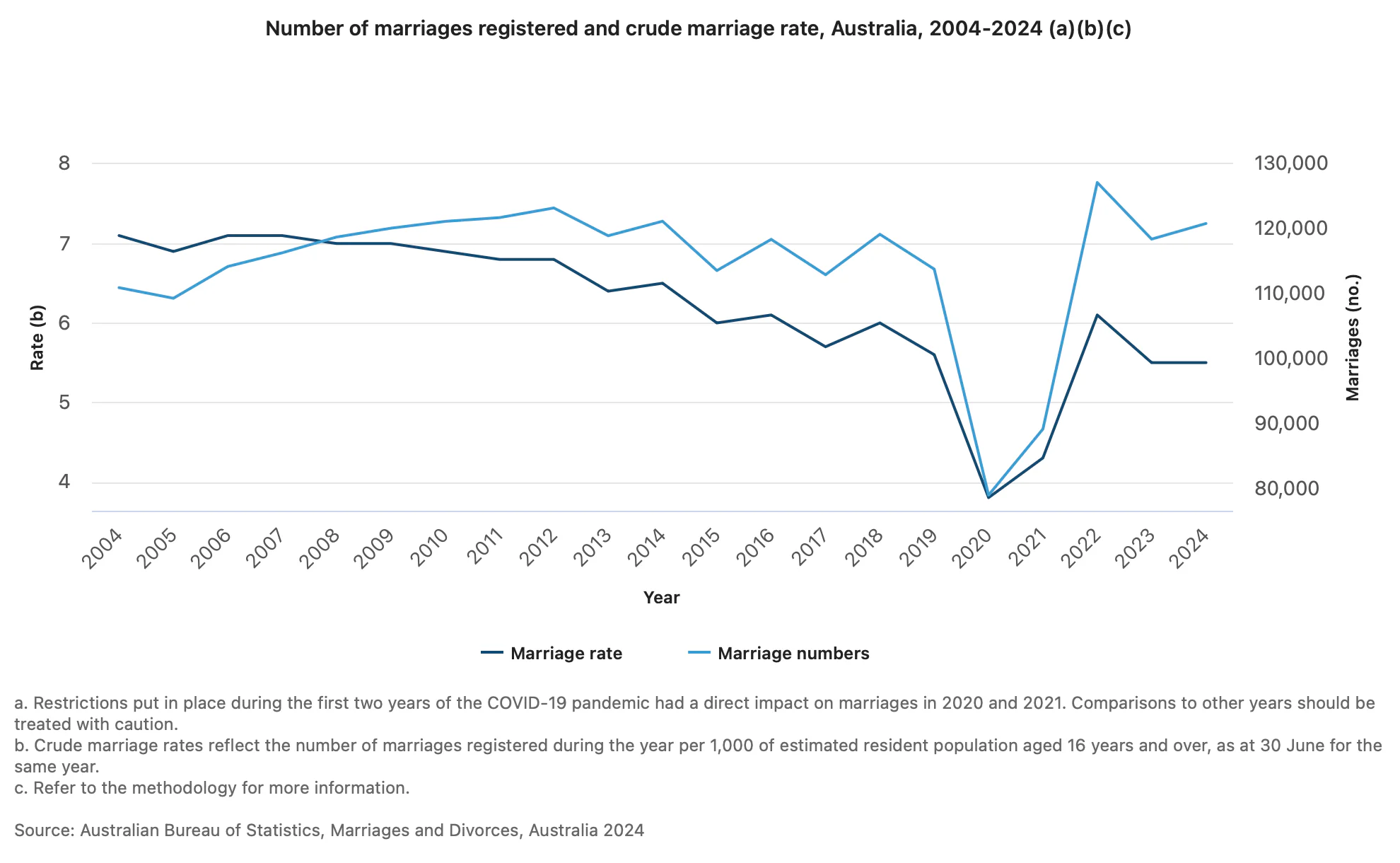
In a surprise literally nobody saw coming, marriage numbers actually increased in 2024, with 2% more marriages occuring than in 2023. 2024 saw 120,844 marriage registered, 2% more than 2023 but still less than the record high of 2022 with the post-COVID catchup. Interestingly, apart from the record high of 2022, this year is the highest number of marriages registered since 2012.
I am genuinely shocked by this, given how we’ve been carrying on about how it feels like less people are getting married. Last year I literally wrote about “the downturn we’ve seen in 2024 with the cost of living crisis etc.” Maybe my other thesis, that people are still getting married but they’re getting married smaller and cheaper, is actually the correct one. That’s one we can’t tell from the stats though.
Here comes the graph again, this time with the slight 2024 increase included.
Gender
Again, I love the info on genders of people getting married. I know a lot of people think we shouldn’t be separating out this information, that marriage is marriage and it doesn’t matter who is marrying whom. But I think it’s interesting. We’ve seen another slight increase in the number of marriages involving at least one person who identifies as non-binary, from 159 in 2022 to 204 in 2023 to 231 in 2024.
The number of marriages of two female-identifying people was almost exactly the same as 2023 (2619 in ’23, 2622 in ’24). The number of marriages of two male-identifying people increased by 9% from 1735 in 2023 to 1893 in 2024. I have no idea what, if anything, that means.
As I mentioned last year, I’ve written on my own blog about my interest in these growing statistics on non-binary people getting married, and whether this tells us something about more common usage of this gender identity in the general population. I’m not a researcher, but I think it’s an interesting question.
Age
The age people get married actually dropped for men (32.8 years as opposed to 32.9 years in 2023) but stayed the same for women (31.2 years old).
Location
New South Wales, Victoria, and Western Australia were responsible for the increase in marriage registrations, with the other five states and territories’ numbers all dropping slightly.
Victoria saw the largest increase in marriage registrations year-on-year, with an additional 2234 (7.5%) marriages registered in 2024. This was significantly larger in percentage terms than other increases: New South Wales saw 1.6% more marriages while Western Australia saw 1.9% more marriages. Victorian celebrants, why did we see such a jump? Any ideas?
As I said previously and above, I still don’t think this is the end of the rebalancing of marriage numbers. We may need to wait another few years to see what happens next.
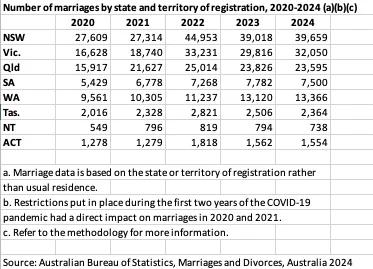
Source: Australian Bureau of Statistics, Marriages and Divorces, Australia 2024
Date
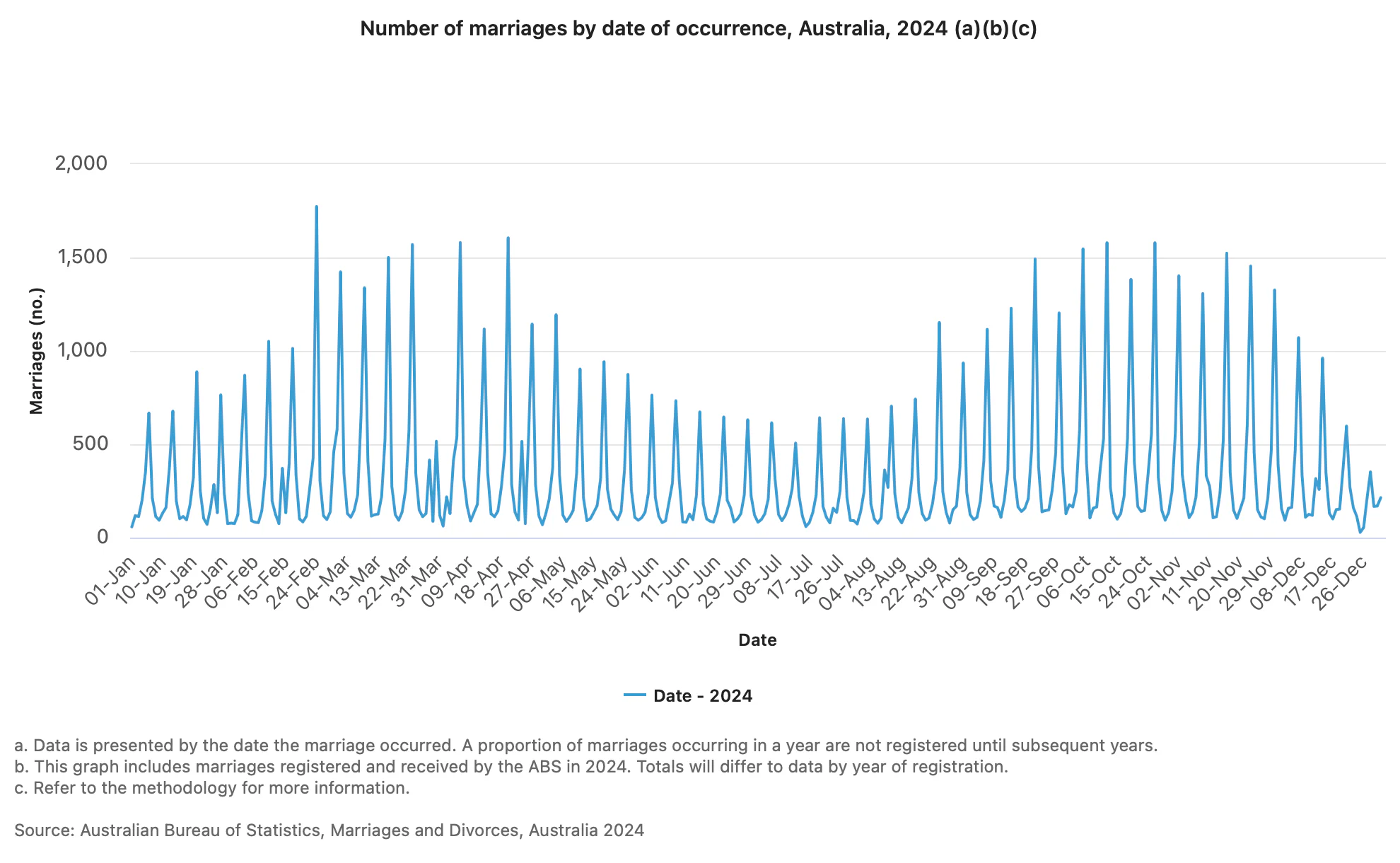
Marriage dates were back to the patterns we used to see prior to COVID-19: peak marriage numbers occur in Spring and Autumn, and lower numbers in Winter, and at Easter and Christmas.
There was another matching numbers date that saw the highest number of marriages in 2024: 24/02/2024 saw 1773 marriages. Other popular dates were 20/04/2024, 06/04/2024 (people love those mathematical dates), 12/10/2024, and 26/10/2024 (both in the expected peak of October).
Here’s a pretty graph showing those lovely Autum and Spring peaks, with rather dramatic drops for Easter and Christmas:
Decreased statistics
From 2022, the ABS decreased the number of statistics they’re releasing on marriage and divorce. This means we no longer have information on things like the split between civil and religious marriages, whether this is people’s second marriage, where people were born (overseas or in Australia). I’m kind of pissed about it, but shy of spending a minimum of $600 (and probably much more) to get more specific questions answered, we’re going to have to make do with what we’ve got. I’m hoping that the next iteration of the NOIM will have a tickbox for Rites Used (civil rites will have one tickbox, religious rites another tickbox, with a free text field for specific type of religious rites), which should make it easier for the ABS to at least collate data on the split between civil and religious marriages.
So that’s my overview of the 2024 marriage and divorce statistics. Let me know if you have any other questions you’d like me to look into!